

Introduction
Learning the Makharij (مخارج) of Arabic letters is one of the most important steps in reading the Qur’an correctly. If you’ve ever felt unsure about how to pronounce certain Arabic letters, you’re not alone. Many students struggle with sounds that don’t exist in their native language. But the good news is that once you understand where each sound comes from, everything becomes much easier.
In this blog, we’ll break down Makharij in a simple, clear, and human way, using relatable explanations, examples, and visual-style descriptions so you can imagine the sound even without a teacher sitting next to you.
What Are Makharij?
The word Makharij (مخارج) means “points of articulation” — the exact places in your mouth or throat where Arabic letters are produced.
Think of it like this:
- Every letter has a home in your mouth.
- If you pronounce it from the wrong place, the sound changes.
For example:
- “ب” (Ba) comes from the lips
- “ق” (Qaaf) comes from deep in the throat
Even a small shift in pronunciation can completely change the meaning of a word in Arabic, especially in the Qur’an.
Why Are Makharij Important?
Correct Makharij ensures:
- Accurate Qur’an recitation
- Preservation of meaning
- Beautiful and clear pronunciation
- Avoiding major mistakes (لحن)
The Prophet ﷺ recited the Qur’an with perfect pronunciation, and we try to follow that same way.
Platforms like Kalamullah online academy emphasize Makharij from the very beginning because it builds a strong foundation for Tajweed.
The Five Main Areas of Makharij
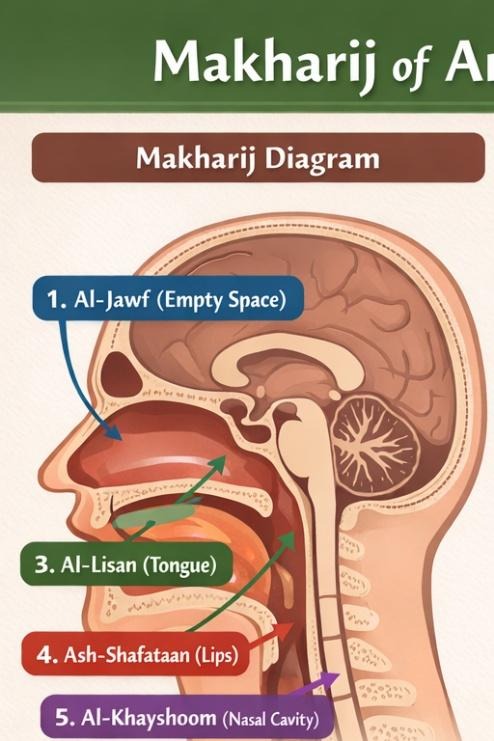
Arabic letters come from five main regions of the mouth and throat:
- Al-Jawf (Empty Space)
- Al-Halq (Throat)
- Al-Lisan (Tongue)
- Ash-Shafataan (Lips)
- Al-Khayshoom (Nasal Passage)
Lets explore each one step by step.
1. Al-Jawf (The Empty Space)
This refers to the open space inside the mouth and throat.
Letters:
- ا (Alif)
- و (Waw – long)
- ي (Yaa – long)
How it works:
These letters are called Madd letters (stretching sounds).
Example:
- قَالَ (Qaa-la)
- يَقُولُ (Ya-qoo-lu)
Tip:
These sounds are soft and stretched, not sharp or blocked.
👉 Imagine the sound flowing freely without hitting any part of your mouth.
2. Al-Halq (The Throat)
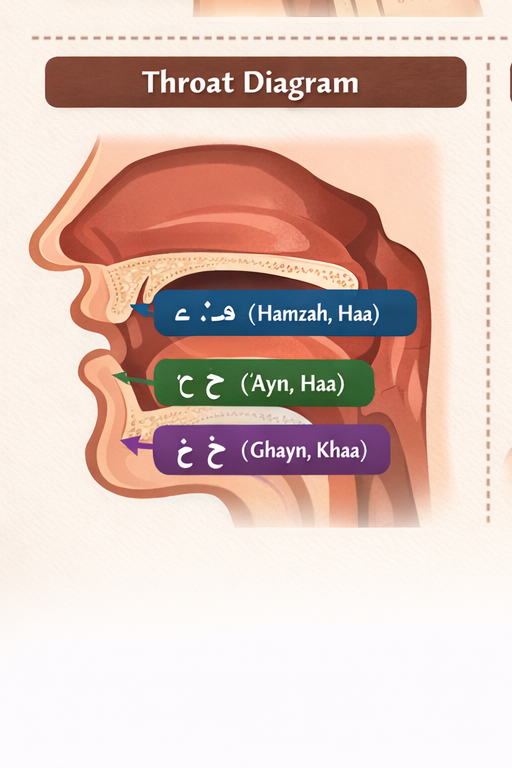
The throat is divided into three parts:
a) Deep Throat (closest to chest)
- ء (Hamzah)
- ه (Haa)
b) Middle Throat
- ع (‘Ayn)
- ح (Haa – soft)
c) Upper Throat (near mouth)
- غ (Ghayn)
- خ (Khaa)
Example:
- حمد (Hamd)
- غفور (Ghafoor)
Visual Guide (Imagine):
- Deep throat = inside your chest area
- Middle = center of throat
- Upper = just before your mouth opens.
Common Mistake:
Students often confuse:
- ح and ه
- خ and ك
👉 Practice slowly and feel where the sound vibrates.
3. Al-Lisan (The Tongue)
This is the largest and most detailed Makharij area.
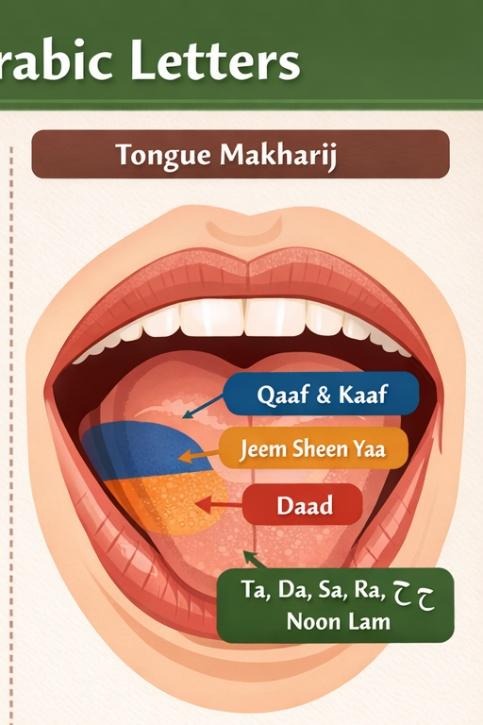
The tongue has multiple positions:
a) Back of Tongue
- ق (Qaaf)
- ك (Kaaf)
Example:
- قلب (Qalb)
- كتاب (Kitaab)
👉 Qaaf is heavier and deeper than Kaaf.
b) Middle of Tongue
- ج (Jeem)
- ش (Sheen)
- ي (Yaa – non-madd)
c) Side of Tongue
- ض (Daad)
👉 This is one of the hardest letters in Arabic.
d) Tip of Tongue (with different positions)
- ط, د, ت → touch upper front teeth
- ص, س, ز → near teeth with airflow
- ر → slightly rolled
- ن → nasal touch
- ل → soft touch behind teeth
Example Words:
- صبر (Sabr)
- نور (Noor)
- رحمن (Rahmaan)
Tip:
The tongue is very flexible small movements create big differences.
This is why structured learning programs like those at Kalamullah online focus heavily on tongue positioning with guided correction.
4. Ash-Shafataan (The Lips)
Letters produced using the lips:
Letters:
- ف (Fa) → upper teeth + lower lip
- ب (Ba) → both lips closed
- م (Meem) → lips closed with nasal sound
- و (Waw) → rounded lips
Example:
- باب (Baab)
- ماء (Maa)
- وجه (Wajh)
Visual Tip:
- “ب” = lips fully close then open
- “ف” = slight touch with teeth
5. Al-Khayshoom (Nasal Passage)
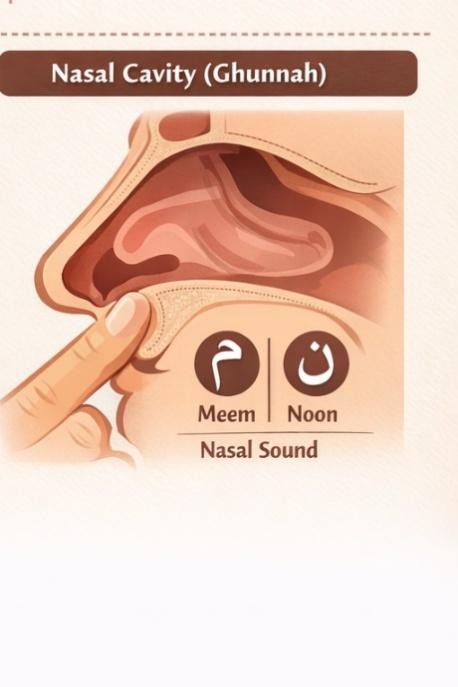
This is the nose area, used for ghunnah (nasal sound).
Letters:
- م (Meem)
- ن (Noon)
Example:
- إِنَّ (Inna)
- أُمّ (Umm)
Tip:
Place your finger on your nose while saying “نّ” — you’ll feel vibration.
Putting It All Together
Let’s take a word:
الرَّحْمَٰن
- ر → tip of tongue
- ح → middle throat
- م → lips + nasal
- ن → tongue + nasal
Every letter comes from a different place, yet they flow together beautifully.
Common Mistakes Students Make
- Mixing similar sounds
- س vs ص
- ت vs ط
- Not using throat properly
- Weak pronunciation of ع
- Ignoring nasal sound (ghunnah)
- Rushing recitation
How to Improve Your Makharij
1. Slow Down
Don’t rush. Focus on each letter.
2. Listen Carefully
Listen to expert reciters like:
- Mishary Alafasy
- Abdul Basit
3. Practice in Front of a Teacher
Self-learning helps, but correction is essential.
4. Record Yourself
Compare your recitation.
5. Consistency
Even 10–15 minutes daily can improve your pronunciation.
Many students benefit from structured Tajweed training through platforms like Kalamullah, where teachers correct Makharij in real time.
A Simple Practice Exercise
Try this daily:
- Read slowly:
ب ت ث
Feel how your tongue moves forward. - Then:
ق ك
Notice the deeper sound. - Then throat letters:
ح خ ع غ
Repeat until you clearly feel the difference.
Why Makharij Is a Journey, Not a One-Day Task
Learning Makharij is not about memorizing rules; it’s about training your mouth and ears.
At first:
- It may feel difficult
- Sounds may seem similar
But with time:
- Your tongue learns automatically
- Your ear recognizes mistakes
- Your recitation becomes natural and beautiful
Final Thoughts
Makharij is the foundation of Tajweed. Without it, even if you know the rules, your pronunciation may still be incorrect.
Take it step by step:
- Learn one group of letters at a time
- Practice regularly
- Seek guidance when needed
Remember, every effort you make in improving your Qur’an recitation is highly rewarded.
As the Prophet ﷺ said:
“The one who recites the Qur’an beautifully, smoothly, and precisely will be in the company of noble angels.”
If you stay consistent and patient, your recitation will improve, and you’ll feel a deeper connection with the Qur’an every day.