
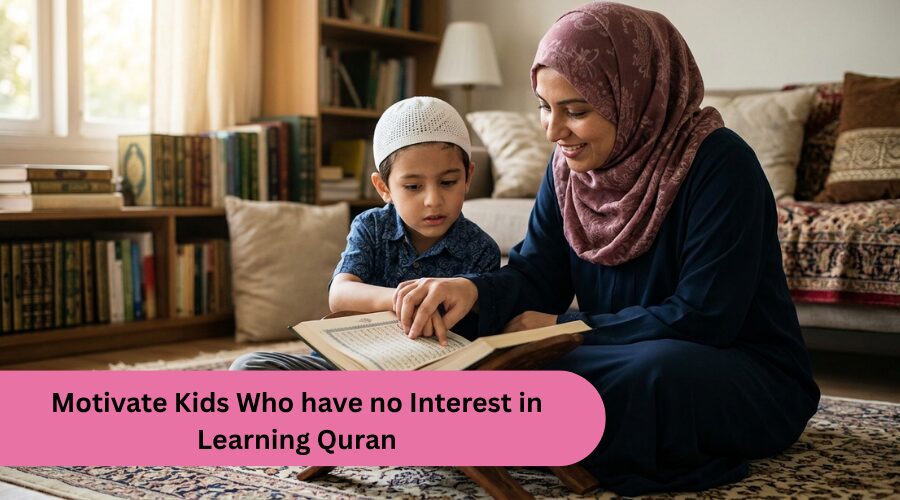
A practical guide for parents who are struggling to build a loving and lasting connection between their child and the Quran.
Introduction
It is 6 p.m. You call your child for Quran class. No response. You call again. This time, you get a groan, then a complaint about being tired, then the famous excuse: “Can I just do it tomorrow?” You sit down feeling a strange mix of frustration and guilt. You want your child to love the Quran, but right now, it feels like a battle you cannot win.
If this sounds familiar, you are not alone. Thousands of parents face this same struggle every single day. Kids who have no interest in learning Quran are not a sign of bad parenting or a faithless child. In most cases, resistance to Quran learning is a signal, and once you understand what that signal means, you can actually do something about it.
This guide is written for parents who are tired of the daily fight and genuinely want to find a better way. Whether your child is six or sixteen, there are practical, realistic steps you can take to shift their attitude toward the Quran, without force, guilt, or pressure.
Signs Your Child Is Resisting Quran Learning
Before diving into solutions, it helps to recognize what resistance actually looks like. It is not always tantrums or flat-out refusal. Sometimes it is more subtle.
- Constantly making excuses to delay or skip sessions
- Crying or becoming irritable right before class
- Sitting through lessons but clearly not engaged
- Forgetting everything taught, even after repeated sessions
- Saying things like “I have no interest in Quran class” or “It is too hard”
- Physical complaints like headaches or stomachaches that appear only at class time
Recognizing these signs early gives you a chance to address the root problem before the resistance becomes deeply ingrained.
Why Kids Dislike Quran Learning: The Real Reasons
Understanding why kids dislike Quran learning is the first step toward changing things. The reasons are rarely about the Quran itself. They are almost always about the experience surrounding it.
Pressure Without Joy
When Quran learning is tied exclusively to obligation and correction, children associate it with stress rather than peace. If every session ends with scolding or comparison to a sibling or neighbor’s child, the child learns to dread it.
The Wrong Pace
Some children are rushed through Qaida and onto longer Surahs before they are ready. When a child cannot keep up, the sense of failure builds quietly. Eventually, the brain starts connecting Quran time with feelings of inadequacy.
No Meaning, No Connection
Children are natural meaning-seekers. When they recite words they do not understand, in a language completely foreign to them, with no stories or context attached, it can feel like an empty exercise. This is one of the most common problems in Quran learning for kids, and one of the easiest to address.
Environmental Distractions
A child sitting in a noisy room, next to their tablet or right after a long school day, is not going to absorb anything. The Quran learning environment matters enormously, and many families overlook this entirely.
Psychological Reasons Behind Lack of Interest
Child motivation is deeply connected to how a child feels about themselves as a learner. If a child has repeatedly been corrected, compared, or made to feel slow, their brain begins to protect itself by avoiding the source of that pain.
This is not stubbornness. It is a psychological response. The brain associates Quran learning with threat rather than reward, and so avoidance feels like the safest option. Understanding this changes everything, because it means your goal as a parent is not to push harder but to rebuild the association entirely.
Common Mistakes Parents Make
Most parents want what is best for their child. That is precisely why these mistakes are so easy to fall into.
- Forcing sessions when the child is already tired or upset
- Making Quran time feel like punishment
- Comparing the child’s progress to siblings or cousins
- Skipping weekends and then cramming sessions on weekday evenings
- Choosing teachers without considering the child’s learning style
- Rewarding only results rather than effort and consistency
None of these make you a bad parent. They are simply patterns that, once you recognize them, you can gently change.
Simple Ways to Build Love for the Quran
Building interest in Quran for kids does not require elaborate techniques. It starts with making the Quran feel safe, beautiful, and meaningful in your home.
Play Quran recitation softly in the background during meals or in the car. Share short stories about the prophets connected to the Surahs your child is learning. Tell your child what a particular verse means in simple language. Let them see you reading the Quran yourself, not just instructing them to read it.
One mother shared that her eight-year-old completely changed after she started sitting beside him during his recitation and simply listening, without correcting every mistake. Within two weeks, he began asking to read on his own. That small shift in her approach made all the difference.
Reward Systems and Positive Reinforcement
Positive reinforcement is one of the most powerful child motivation techniques for learning, and it works beautifully with Quran education when applied thoughtfully.
Here is a simple approach you can start this week:
- Create a progress chart with your child and let them place a sticker for each completed session
- Celebrate milestones like finishing a new Surah with a small treat or family acknowledgement
- Praise effort, not just accuracy. “I noticed how hard you tried today” means more than “You got it right”
- Let your child choose one short Surah or dua they personally want to learn alongside the curriculum
- Give them a sense of ownership by letting them set their own small weekly goal
The goal of rewards is not to bribe but to help your child build a positive association with learning until intrinsic motivation can take root naturally.
The Role of Teaching Style and Environment
If the current teaching approach is not working, changing it is not giving up. It is good parenting. Some children learn best through repetition and structure. Others need movement, storytelling, or visual cues. A teacher who matches your child’s learning style can transform the entire experience.
The physical environment also plays a bigger role than most parents realize. Set up a dedicated, calm space for Quran learning. Remove screens from that space. Choose a time of day when your child is genuinely alert, even if that means adjusting the schedule. A Quran learning routine for kids that respects their natural rhythms will always produce better results than one imposed purely out of convenience.
Benefits of Interactive Online Quran Classes
For many children, the traditional madrassa model can feel rigid or intimidating. Online Quran classes for children offer a different and often more effective environment, particularly for kids who have developed an aversion to learning.
In a one-on-one online setting, the child gets the teacher’s full attention without the social pressure of performing in front of peers. Sessions can be tailored to their exact level, pace, and personality. The child can learn from the comfort of their own home, in a familiar space where they already feel safe.
Platforms like Kalamullah online have helped many families navigate this exact challenge. With qualified teachers who understand how children learn, and flexible scheduling that works around school and family life, Kalamullah online Quran classes provide a structured yet warm learning experience. The focus is not just on recitation accuracy but on making the child feel capable, valued, and connected to what they are learning.
If your child has been struggling with in-person classes, it may be worth exploring whether learning online is a better fit for their temperament. Many parents who chose to learn Quran online with Kalamullah have noticed a significant shift in their child’s attitude within just a few weeks, simply because the environment finally felt right.
Fun Ways to Teach Quran to Kids at Home
Tips to make Quran learning interesting do not have to be complicated. Here are some daily Quran practice tips that parents have found genuinely effective:
- Use storytelling to explain the context of Surahs before the child reads them
- Turn memorization into a gentle call-and-response game at the dinner table
- Watch short, age-appropriate Quranic story videos together and discuss them
- Let your child teach back a verse they have memorized to a younger sibling or even a stuffed animal
- Use a whiteboard or colorful notebooks to write out Arabic letters they are learning
- Connect verses to real-life situations so the words carry personal meaning
Consistency matters more than quantity. Even ten engaged minutes a day is more valuable than an hour of reluctant sitting.
Long-Term Habit Building Strategies
The goal is not just to get through today’s lesson. The goal is to raise a child who wants to return to the Quran throughout their life. That kind of relationship is built slowly and intentionally.
Start small. If your child currently refuses to sit for more than five minutes, make five minutes the standard and do it every day. Regularity creates familiarity, and familiarity creates comfort. Once the resistance drops, you can gradually increase the time.
Make Quran a part of your family culture rather than an isolated task. When the Quran is something the whole household is engaged with, children absorb that naturally. They want to be part of what their family values.
Also, check in with your child regularly. Ask them how they feel about their learning, what they find hard, and what they wish was different. Children who feel heard become children who trust the process. And children who trust the process keep going.
A Final Word for Tired Parents
If you have reached this point feeling a little overwhelmed, take a breath. The fact that you are searching for better ways to help your child shows exactly the kind of parent you are. This path is not about being perfect. It is about being present, patient, and consistent.
Children who struggle with Quran learning today are not doomed to a life of disconnect from it. With the right environment, the right teacher, and a parent who refuses to give up on them, even the most resistant child can find their way to the Quran, not because they were forced to, but because they were loved into it.
Whether you adjust your approach at home, look for a more patient teacher, or explore online Quran classes through a trusted Kalamullah online Quran academy, the important thing is that you keep trying. The Quran is patient. So can you be.
May Allah make it easy for your child, and for you.